
Development Cooperation and Interreligious Dialogue for International Law
Updated: 4 days ago
GUEST ADDRESS · MODENA, JUNE 2026
FEDERAZIONE DEGLI ORGANISMI
DI VOLONTARIATO INTERNAZIONALE DI INSPIRAZIONE CRISTIANA
FEDERATION OF CHRISTIAN-INSPIRED ORGANIZATIONS
FOR INTERNATIONAL VOLUNTEERING
FOCSIV
Seminar
“Development Cooperation and Interreligious Dialogue for International Law”
(Modena, June 5, 2026)
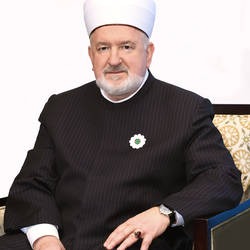
Mustafa Cerić, Ph. D.
Grand Mufti Emeritus of Bosnia
From the Promise of Progress to the Fear of Decline:
A Reflection on the Crisis of Contemporary Civilization
Honorable Madam Ivana Borsotto, President of FOCSIV, Esteemed Religious Leaders, Respected Scholars, Eminences, Excellencies, Ladies and Gentlemen,
Allow me first to express my gratitude for the invitation to participate in this important gathering. At a time when humanity witnesses unprecedented suffering caused by wars, displacement, poverty, and the erosion of trust among nations, our meeting is both timely and necessary.
Let me begin by saying that when I was a young man growing up in the second half of the twentieth century, humanity lived under a powerful conviction: tomorrow would be better than yesterday.
Despite the shadows of world wars, ideological conflicts, and economic hardships, there was a widespread belief that history had a direction and that this direction pointed toward progress. Science would cure diseases. Education would eradicate ignorance. Economic development would reduce poverty. International institutions would prevent wars. Human rights would become universal. The future was imagined as a horizon of hope.
Today, in my seventieth year of life, I hear a different voice.
Across continents, cultures, and generations, people increasingly believe that tomorrow may be worse than today.
Climate anxiety, wars, economic uncertainty, demographic decline, technological disruption, loneliness, political polarization, and spiritual exhaustion have created an atmosphere of civilizational pessimism. For the first time in modern history, many parents fear that their children may inherit a world less stable, less peaceful, and less humane than the one they themselves received.
This raises a profound question:
What has happened to the human spirit?
And even more importantly:
Do the sacred traditions offer a path beyond this collective despair?
The Paradox of Material Success and Spiritual Failure

Objectively speaking, humanity has never possessed greater material power.
We have conquered diseases that once decimated populations. We communicate instantly across continents. We have mapped the human genome and explored outer space. The average human being today enjoys technological possibilities unimaginable to previous generations.
Yet paradoxically, the increase of power has not produced a corresponding increase in meaning.
The modern world has solved many practical problems while simultaneously creating a crisis of purpose.
We know more than any previous generation, yet we are less certain why we exist.
We possess unprecedented means, yet we increasingly lack shared ends.
We are globally connected, yet existentially isolated.
The crisis before us is therefore not primarily political or economic. It is spiritual.
The deepest question of our age is not whether humanity can survive technologically, but whether it can survive morally and spiritually.
The Disappearance of Transcendence
One of the most significant transformations of modern civilization has been the gradual eclipse of transcendence.
For centuries, human beings understood themselves within a larger cosmic narrative. Whether through Judaism, Christianity, Islam, or other religious traditions, life possessed an ultimate meaning beyond immediate material concerns.
Human dignity was grounded in divine purpose.
History was understood as morally significant.
Hope was rooted in something greater than political success or economic prosperity.
Modern secular civilization sought to liberate humanity from many forms of oppression, and in many respects it succeeded. Yet in the process, it often replaced transcendence with consumption, wisdom with information, and meaning with efficiency.
The result has been what many contemporary philosophers describe as a crisis of the soul.
A civilization can survive poverty.
It can survive military defeat.
It can survive political turmoil.
But it cannot survive indefinitely if it loses faith in the meaning of its own existence.
The Return of Fear
The optimism of the twentieth century was built upon confidence in progress.
Today’s pessimism emerges from the fear that progress itself has become uncontrollable.
Technology no longer appears merely as liberation; it appears as a potential threat.
Globalization no longer appears merely as cooperation; it appears as vulnerability.
Artificial intelligence no longer appears merely as innovation; it raises questions about human identity itself.
The future, once perceived as a promise, is increasingly perceived as a risk.
This transformation reveals a profound truth:
Human beings do not live by material achievements alone.
Without moral confidence and spiritual orientation, even abundance can produce anxiety.
What Do the Sacred Scriptures Tell Us?

The remarkable fact is that the great sacred traditions anticipated such moments.
The Qur’an teaches:
“Indeed, Allah does not change the condition of a people until they change what is within themselves.” (13:11)
The crisis of civilization therefore begins not in institutions but in hearts.
The Bible similarly reminds us:
“What shall it profit a man if he gains the whole world and loses his soul?” (Mark 8:36)
The question confronting contemporary civilization is precisely this.
Can a civilization gain the world while losing its soul?
The answer provided by the prophetic traditions is clear:
No civilization can endure if it forgets the moral foundations upon which it rests.
The prophets did not merely warn about political corruption.
They warned about spiritual forgetfulness.
They warned about arrogance, injustice, greed, and the illusion that power alone could secure the future.
Is There Hope?

The answer of revelation and human experience is unequivocal: yes.
But hope is not optimism.
Optimism believes that things will automatically improve.
Hope believes that meaning remains possible even in difficult times.
The sacred traditions teach that periods of crisis often precede periods of renewal.
The Qur’an repeatedly associates hardship with opportunity:
“Indeed, with hardship comes ease.” (94:6)
Not after hardship.
With hardship.
This distinction is crucial.
The seeds of renewal are already present within the crisis itself.
Every period of civilizational decline has generated new moral awakenings.
The collapse of old certainties often creates space for deeper wisdom.
The exhaustion of materialism often awakens the search for meaning.
The failure of power often renews appreciation for justice.
The experience of fragmentation often inspires a renewed longing for community.
The Forgotten Virtue of Trust
Perhaps the deepest illness of our age is the erosion of trust.
We distrust institutions.
We distrust governments.
We distrust one another.
Many people have even begun to distrust the future itself.
Yet every great civilization has been built upon trust.
Trust between generations.
Trust between communities.
Trust between nations.
Trust between humanity and God.
Islam calls this trust amānah.
Christianity speaks of faith.
Judaism speaks of covenant.
Different traditions use different language, but they point toward the same reality:
Human beings flourish when they believe that life is meaningful and that goodness ultimately matters.
Without trust, civilization becomes a collection of fearful individuals.
With trust, it becomes a community capable of hope.
Toward a New Humanism

The answer to contemporary pessimism is not nostalgia.
We cannot return to the past.
Nor can we solve spiritual problems through technology alone.
What humanity requires is a new moral and spiritual synthesis—a new humanism rooted in the dignity of the person, the sanctity of life, the responsibility of freedom, and the recognition of our common destiny.
Religious communities have a vital role in this task.
Not because they possess all the answers.
But because they preserve the wisdom that human beings are more than consumers, producers, voters, or data points.
They remind us that every human person possesses an inherent dignity that no market can measure and no state can grant.
Conclusion
When I was young, humanity believed that tomorrow would be better than yesterday.
Today many believe that tomorrow will be worse than today.
This change tells us something important.
It tells us that material progress alone cannot sustain hope.
It tells us that civilizations require not only wealth and power but also meaning and purpose.
It tells us that the future is ultimately a spiritual question.
The sacred books and the accumulated experience of humanity suggest that despair is never the final word.
History is not merely a story of decline.
It is also a story of renewal.
Whenever humanity rediscovers justice after oppression, compassion after cruelty, wisdom after confusion, and faith after doubt, a new chapter begins.
Our challenge today is not simply to defend international law, democracy, or economic development.
Our challenge is to recover confidence in the moral and spiritual foundations that make these achievements possible.
The future will not be secured by power alone.
It will be secured by wisdom.
And wisdom begins when humanity remembers that it is accountable not only to history, but also to conscience, and ultimately, to God.
Thank you.
About the Author

Mufti Dr. Mustafa Cerić
Member of the Council of Interfaith, Salvator Mundi Global
Former Grand Mufti of Bosnia and Herzegovina, serving from 1993 to 2012, Islamic scholar and one of Europe’s leading voices for interfaith dialogue and reconciliation.
©2026 by Salvator Mundi Global Limited | Powered by Ethics™


Comments