
Message in a Bottle: What Thirty Three Years of Wine Have Taught Me
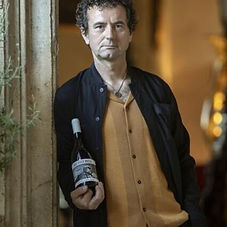
Last Sunday I was invited to the Salvator Mundi Café, and I asked Mario Diel one favour: let me bring my friends. I move with the theme, and my theme is always friends. I wanted a dialogue, not a monologue. What I could tell you alone is limited. What we can tell you together is a picture of Italy.
Mario chose the title, Message in a Bottle, after the song Sting wrote with The Police. It suits me, because since 2007 I have worked with Sting and Trudie Styler at Tenuta Il Palagio. But I want to share a different message here, the one every bottle carries if you know how to listen.
How a Palate Is Built

I started in 1993 in restaurants, in Genoa, Chicago and Florence. In 2001 I met Daniel Thomases, the critic who wrote for the Veronelli Guide and for Robert Parker. He received thousands of samples and needed a place to taste them, and he used my restaurants and my wine shop. For almost twenty years I tasted beside him, 2,000 to 3,000 wines a year, sometimes a hundred in a day. You do not learn this from a book. After a while you simply know what is in the glass.
From there I became what I call a modern merchant of wine, il mercante del vino. I did not sell for wineries. I advised importers abroad, in South Korea, in Japan, in the United States, who did not yet know Italy, and I found them the right producers. Farmers were suspicious at first: why would someone help without asking for money? My answer was simple. If I am good at what I do, I will earn when I find the right fit. Over the years more than 100 importers trusted me.
What still excites me most is this: I put the same wine in front of five importers from five countries, and I hear five different descriptions. Every culture tastes through its own kitchen, its own parents, its own memories. Italy has more than 300 indigenous grape varieties. It is not a country. It is a garden.
The Truth About the Market Today

I will not pretend everything is easy. Production has grown and demand has not, so sales are falling. People talk about alcohol and health, and I agree that alcohol is not healthy. But let us be honest: someone with a drinking problem does not drink fine wine.
Here is a number that says everything. Good Tuscan bulk wine, the everyday IGT category, sells today for about 1 to 1.20 euro per litre. That is half the price of diesel. Bulk wine moves like the stock market, pushed by finance and by five years of conflict nobody expected.
On American tariffs, I usually stay diplomatic, but here I will say what I think. The tariffs are not the problem. Five, ten, fifteen or twenty percent, a business can plan for any of these. The problem is not knowing what next month will bring. Uncertainty freezes orders.
Where the Future Is

The future is in experience. Visitors who come to the winery, meet the people, taste in the place and buy. My friend Violante Cinelli Colombini told our Café that wine tourism is growing by 12 percent while consumption falls. Her family's story is my favourite proof: they received the "unlucky" northern slope of Montalcino in 1998, a ruin with a tree growing inside the building. Her mother built the first winery in Italy run entirely by women, at a time when the oenology school told her nobody wanted to employ its best graduates because they were women. Today, with hotter summers, everyone wants that fresh, windy, clay rich northern slope. As I told her, she can raise a glass to global warming.
Four years ago I created The Sound of Wine, short films that tell the story of a territory through music and sound. Forbes listed it among its 100 Italian excellences, and Sky Arte asked for episodes. Wine needs new languages.
Wine Must Learn to Speak Again

Sally Benbasat asked me why wine is so hard to advertise. Because wine is agriculture. It is not fashion, not cars, not finance, not pharma. Most producers are in the field all day, with no time and no budget, and every one of them believes his wine is the best, the way we all believe our child is the best.
And we communicate it badly. Too austere, too technical, to people whose attention lasts seconds. The sommelier who wants to show you how much he knows is not what today's consumer is looking for.
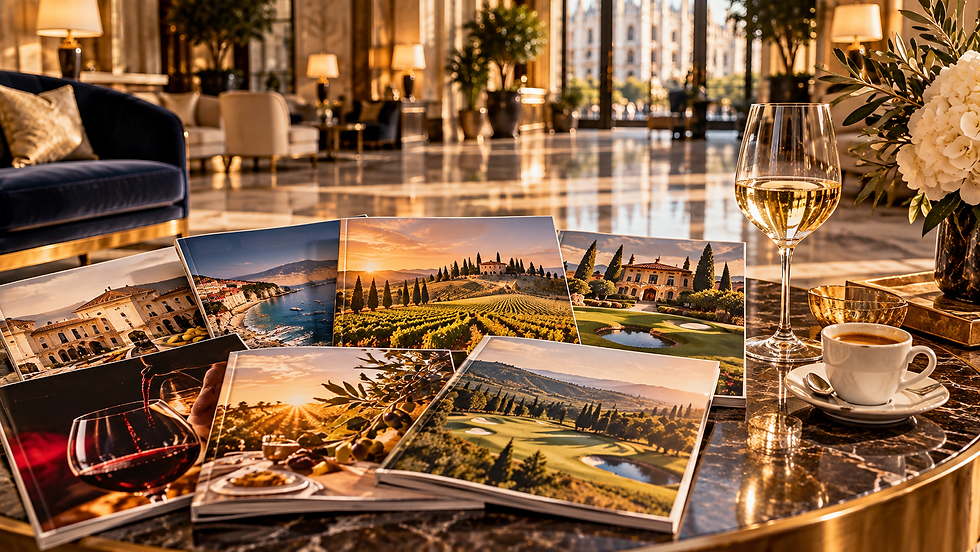
That is why I invited Diego Bormida. I have always said the wine must speak for itself, but Diego proved the bottle can speak first. His artistic bottles for Santero 958, in some years, sold more than a million units. On a shelf of a hundred labels, we choose a bottle the way we choose a book: by its cover. And Marco Sutter, who publishes luxury titles in thousands of hotels, reminded us that a magazine is a magical business card. Vivia Ferragamo added what every creator knows: the hardest part is not making the product, it is distribution and marketing.
About Young People and Technology

People ask me how to convince the young to drink wine. My answer surprises them: we are not here to convert anyone. If young people drink less, thank God. I did not drink wine at 21 either. Wine comes later, with its ritual: opening the bottle, the steak, the conversation, the conviviality. Our daughter is 20, and she would rather put the music on and dance. Good.
Björn Söderberg asked if artificial intelligence or holograms could help. Maybe a hologram on a bottle adds a little value. But nobody buys a bottle to watch a half hour story, and the best wine for your fillet mignon is simply the wine you like. Artificial intelligence cannot understand my palate.
Why Il Palagio Is Not Just a Name

Some people ask if a famous name on a bottle is only marketing. At Tenuta Il Palagio, near Florence in Figline Valdarno, it is not. Sting and Trudie Styler own the estate. It is their home. Trudie leads the project as creative director, and for Sting it is a passion beside music. They restored the vines and gave them new life. We produce extra virgin olive oil that has won many awards, with the harvest starting in two weeks, and honey from 80 bee colonies and more than ten different flowers. We have a farm shop pizzeria you are welcome to visit. And our wines are honestly priced. Trudie and Sting are the cherry on top of the cake.
The Message
I call myself a yes man. Whoever asks me, I say I will try. Sometimes people take advantage. I do not care. I care about human beings, and every day I fall in love with people a little.
That is the message in the bottle. A wine is never only a wine. It is a place, a family, a risk taken on an unlucky slope, an artist's hand on a label, a friend who opens a door. What lasts is what is real.
I hope to welcome the Salvator Mundi Global community to Il Palagio soon. Until then, open something good, and share it with someone.
Watch the Full Session
About the Author

Tony Sasa
Sales Director, Tenuta Il Palagio, the Tuscan estate of Sting and Trudie Styler
International wine expert with more than 30 years in the Italian wine trade, former consultant to more than 100 importers worldwide, and creator of The Sound of Wine.


Comments