
Before the Violence: Popular Culture and the Formation of Prejudice
A critical review essay
Bias in Popular Culture: The Power of Visual and Linguistic Narratives
Anas Al-Shaikh-Ali, Mahya Yayıncılık, 2023, 384 pages
This review examines the argument presented in the supplied description and the publisher’s materials; it does not claim a chapter-by-chapter assessment of the full book. The accompanying passage about war is considered separately, since its authorship is unspecified.
A society’s capacity to discriminate begins partly in its habits of seeing. Before exclusion becomes a policy, it can become an expectation; before violence becomes an action, it can acquire a vocabulary of justification. An image teaches viewers whom to fear. A story distributes innocence and suspicion. A joke makes contempt socially comfortable. Through such ordinary encounters, people may learn to regard the humanity of others as conditional.
Anas Al-Shaikh-Ali’s Bias in Popular Culture directs attention to this formative space between representation and public judgment. The publisher describes a study of the visual and linguistic mechanisms through which popular culture shapes opinion, using symbols, metaphors, stereotypes and slogans across fiction, art, film, theatre and political satire. Its central invitation is to take the cultural formation of prejudice seriously: entertainment can carry political assumptions precisely when its audience is least prepared to examine them.
Culture and Power
The significance of this argument lies in its challenge to a convenient division between culture and power. A film may influence political imagination without advocating a policy. A children’s illustration may establish a hierarchy of belonging without stating a doctrine. A fictional antagonist may make a religious community appear threatening without directly addressing religion. Cultural power often operates through the assumptions a narrative allows its audience to leave unquestioned.
The resulting problem is epistemological as well as ethical. How do we come to believe that we know people whom we have never encountered? Which representations become substitutes for experience? Who possesses the authority to define another community, and what happens when the represented people cannot answer with comparable reach?
These questions give the book’s announced project an importance extending beyond criticism of individual offensive images. They concern the conditions under which public knowledge is made.
The Unequal Distribution of Personhood
Every representation selects. No novel, painting or film can contain the totality of its subject. Selection alone, however, does not establish prejudice. The relevant question is whether selection repeatedly gives a group a restricted moral identity. When members of one community are allowed vulnerability, humour, individuality and change, while members of another appear chiefly as threats or curiosities, the imbalance affects the audience’s understanding of personhood.
A stereotype is more than an inaccurate description. It can function as an unequal distribution of narrative possibility. Some people are permitted to become persons; others remain examples of a category.

Consider a hypothetical narrative pattern: wrongdoing by a member of the dominant group receives a personal explanation, while wrongdoing by a minority character is presented as evidence of cultural essence. One person has motives; the other has an identity. Such a pattern makes collective suspicion easier to sustain, because the narrative has already taught its audience which acts should be generalized.
This is an interpretive extension of the book’s stated concern, rather than an assertion about a particular example within its pages. It clarifies what an academically persuasive analysis of cultural bias must investigate: recurring distributions of agency, complexity, credibility and sympathy.
Seeing and Saying
The title’s conjunction of visual and linguistic narratives is especially productive. Images and words can reinforce each other while appearing to provide independent confirmation. A caption supplies an interpretation; an image lends that interpretation apparent immediacy. In fiction, dialogue explains what viewers should understand, while costume, setting, lighting and composition establish what they should feel.
A viewer may experience the resulting judgment as recognition rather than persuasion. This is where cultural bias can become durable: the audience no longer remembers receiving an argument, because the representation seems to have shown a reality.
Yet images do not interpret themselves. Framing, omission, sequencing and juxtaposition influence their meaning. A photograph can record something real and still be used misleadingly. A fictional scene can be openly invented and nevertheless help establish expectations about real communities. The academic task is to examine these relations without assuming that every disturbing image is false or every selective representation is malicious.
The language of public life requires a similar discipline. Euphemism can distance an audience from suffering. Collective labels can erase differences among individuals. The selective assignment of active and passive verbs can make responsibility visible in one case and obscure it in another. A responsible reader asks who acts, who suffers, whose account receives authority, and which alternatives remain outside the frame.
The Voice of War
The accompanying passage about war offers a forceful literary illustration of these concerns. Its speaker appears to be war itself, describing the conversion of religion, race, territory, historical memory and pride into instruments of mobilization. The flag and the enemy become emotional shortcuts; political speakers compete for memorable phrases while ordinary people endure their consequences.
The passage is powerful because it challenges the aesthetic presentation of violence. Political language can make destruction sound elevated, even redemptive. Honour and glory may become verbal coverings for acts whose concrete reality is bodily injury, displacement, bereavement and fear. The text exposes the distance between the grandeur of public rhetoric and the vulnerability of those who must live beneath it.
Its deepest insight is temporal. War’s speaker claims that the end of shooting does not mark the end of suffering. The battlefield continues in nightmares, in family absence, in children’s apprehension and in parents’ waiting. This movement from public spectacle to private aftermath forces the reader to reconsider what conventional narratives of victory leave out.

Read alongside Al-Shaikh-Ali’s stated project, the passage suggests that cultural analysis
should follow violence beyond its heroic framing. What does a triumphant image conceal? Which survivors disappear from the story once a victory has been declared? What forms of suffering resist the rhythm of an anthem or the compression of a slogan?
Nevertheless, the passage itself requires critical qualification. Its personification gives war a single voice and seemingly unlimited agency. Historically, responsibility belongs to identifiable institutions, leaders, perpetrators and decisions. A universal lament can obscure those distinctions if treated as a complete political explanation.
Likewise, its claim that nobody wins expresses the human devastation of war more effectively than it describes every struggle over aggression and defence. A community’s survival, the defeat of an aggressor and the protection of threatened people remain morally consequential. Recognizing war’s terrible costs does not require treating aggressor and victim as interchangeable.
This qualification strengthens the passage’s ethical value. The rejection of militaristic spectacle should accompany precise judgments about responsibility. Compassion becomes more credible when it refuses both glorification and false equivalence.
Intention, Effect and the Audience
The book’s concern with manipulation also calls for analytical differentiation. Deliberate propaganda, inherited stereotypes, commercial incentives, institutional conventions and unreflective repetition can produce similar representations through different processes. A creator may consciously manufacture hostility; another may reproduce a familiar convention without examining its history.
Such differences matter. Harmful effects do not prove coordinated intention, and an absence of malicious intention does not cancel harmful effects. Scholarship must investigate production, circulation and reception separately before connecting them.
For the same reason, the strong claim in the supplied description that public opinion does not grow organically should be understood with care. Opinion emerges through interactions among cultural institutions, political interests, personal experience, social relationships and audience choices. It is neither wholly spontaneous nor wholly engineered.
The strongest version of the book’s announced argument is that people’s judgments develop within environments already structured by unequal visibility and authority. Those environments can shape the available terms of recognition while leaving room for dissent, reinterpretation and resistance.
The description’s emphasis on passive consumers therefore raises an important question about audience agency. People sometimes absorb stereotypes, but they can also challenge, parody or reject them. A representation does not produce identical meanings for all viewers. Personal experience and competing narratives can interrupt its persuasive force.
An adequate account of bias needs to explain both its reproduction and its failure. When do audiences recognize manipulation? What enables an inherited image to lose credibility? Which cultural forms allow those previously stereotyped to become interpreters of their own experience?
These are constructive questions arising from the project. Without the full text, they should not be presented as demonstrated omissions in the book.
Islam, Prejudice and Consistency
Its relevance to representations of Islam and Muslims is evident in the publisher’s materials, which emphasize anti-Muslim bias across several cultural forms. The larger intellectual issue is the reduction of an internally diverse religious world to a restricted repertoire of danger, backwardness or spectacle.
The ethical defence of Muslims rests on an elementary principle: responsibility must remain connected to evidence about persons, actions and institutions. Criticism of a policy, movement or interpretation should not automatically become suspicion toward everyone who shares a religious identification.
The same principle must apply consistently to antisemitism and other forms of collective prejudice. A critique of dehumanization loses integrity when it protects one community by reducing another to a hostile essence. Neither “the West” nor any religious civilization should become a substitute for careful distinctions among institutions, traditions and individuals.
A Bosnian Reading
For a Bosnian reader, these questions carry particular moral resonance. One can read the book’s announced concern as an invitation to examine how neighbours become narratively distant: how an inherited name, religious practice or historical affiliation is made to stand for an allegedly permanent threat.

This application does not claim that popular culture alone causes collective violence.
Material interests, political organization, coercive institutions and decisions are indispensable to explanation. Cultural representations can, however, help supply the categories through which people interpret those forces and judge their consequences.
Nor should responsible comparison flatten historical differences. Analogy is useful when it identifies a mechanism for further investigation; it becomes misleading when it treats distinct histories as identical. Preserving the specificity of victims and responsibility is part of resisting the distortions the book asks us to recognize.
Images in the Digital Age
The digital implications of the argument can be developed along similar lines. As an extension of the book’s concern, a short clip, isolated image or repeated slogan may carry assumptions whose context viewers never encounter. The scholarly response should investigate particular platforms and audiences, rather than infer uniform effects from circulation alone.
A further extension concerns synthetic images and automated text. The problem is not only whether a representation is authentic, but whether familiar cultural patterns make an invented representation seem plausible. Verification and the examination of stereotypes consequently address different dimensions of the same vulnerability.
The educational response should exceed the instruction to identify false information. Cultural literacy also asks how a truthful detail can be arranged into an unjust generalization.
Students need to examine omissions, framing, narrative perspective and the distribution of sympathy, while testing their own preferences as carefully as those of opponents.
The necessary alternative is greater freedom to understand. Critical literacy equips people to distinguish evidence from association, individual conduct from collective identity, and moral judgment from inherited suspicion. It also enables richer cultural production, in which people are represented as agents capable of complexity and change.
The Question That Remains
Al-Shaikh-Ali’s announced project deserves serious attention because it brings these ordinary encounters with culture into the domain of public responsibility. A full assessment of its research would require examining its source selection, historical contextualization, interpretive consistency and evidence of audience effects. Those criteria remain essential to any definitive scholarly judgment.
On the material available, however, the book presents a substantial and necessary question: how does representation prepare the ground on which societies decide whom to trust, whom to fear and whose suffering to recognize?
The war passage gives that question an unforgettable human horizon. Behind the memorable phrase are people who must live with its consequences. Behind the victorious image are survivors whose grief may never enter the public account.
The task of scholarship is to restore those concealed relations to visibility. The task of ethical culture is to sustain recognition before fear narrows it. A society capable of seeing others in their full humanity has a stronger defence against those who would turn difference into danger and danger into permission for cruelty.
About the Author
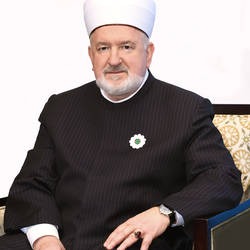
Mufti Dr. Mustafa Cerić
Member of the Council of Interfaith, Salvator Mundi Global
Former Grand Mufti of Bosnia and Herzegovina, serving from 1993 to 2012, Islamic scholar and one of Europe’s leading voices for interfaith dialogue and reconciliation.


Comments