
AMERICA THAT OVERCAME THE FEAR OF ITSELF
A Reflection on Tuesday, November 3, 2026
There are days that pass unnoticed, and there are days that remain within a human being as though they had never passed at all. Not because they changed the world in an instant, but because they changed our belief that the world could still be changed.
There are countries in which a person lives, and there are countries that live within a person. In the former, one is born, grows up, works, suffers, and dies. The latter one carries within oneself as a memory, as a hope, sometimes as an unhealed wound, and sometimes as a promise not entirely fulfilled, yet never entirely abandoned. For me, America is one of those countries.
I was not born there. I did not spend the greater part of my life there. Yet it was there, during a decisive period of my youth, that I encountered something a human being cannot easily forget: the feeling that one may think with one's own mind, speak with one's own voice, believe with one's own heart, and be what one truly is without having to ask anyone's permission.
For that reason, America has never been merely a country to me. It was an experience. It was an encounter. It was a school of freedom. It was a place where I, a young Muslim from Bosnia, learned that the greatness of a society rests not merely upon its power, wealth, or military strength, but upon its capacity to welcome a human being who does not resemble the majority, who prays to God differently, who remembers history differently, and who imagines the future differently. And so, on Tuesday, the third of November in the year two thousand and twenty-six, I felt like a man who, after wandering for many years through the disappointments of others, had suddenly discovered a window opening upon his own youth. On that day, I was not merely watching American elections. I was watching my memories.
I was watching the America I had known in the nineteen-eighties, when, at the University of Chicago, I learned that knowledge has no homeland, but that every true homeland must make room for knowledge; that faith need not be the enemy of freedom, nor freedom the enemy of faith; that a human being may be deeply devoted to God while remaining open to a world that does not share his beliefs. And I asked myself, as I had so often asked in recent years: Where had that America gone? Had it truly disappeared, or had it merely withdrawn before those who were louder, harsher, and more ruthless? Had it grown weary of its own ideals, or had those ideals been nothing more than a beautiful story that we, foreigners grateful for its hospitality, had taken more seriously than some of its own citizens?

A person does not easily renounce what he has once sincerely loved. It is even harder to admit that he may have been mistaken in his love. Thus, in recent years, I carried two Americas within me: the America I remembered and the America I witnessed; the America that taught me dignity and the America that increasingly frightened me with its intolerance; the America that believed freedom belonged to everyone and the America in which some had begun to speak as though freedom belonged to them alone. Between those two Americas stood a man who had persuaded many that his will was the will of the people, that his word was the truth, and that his power was the destiny of America. Donald Trump.
What troubled me was not so much his political power as the willingness of so many people to surrender their own judgment before that power. For power that demands obedience is nothing new in human history. Far more troubling is the human weakness that begins to regard obedience as virtue, fear as wisdom, and silence as patriotism.
For a long time, I believed America was too great to be contained within a single man. And then I watched as its greatness was increasingly reduced to one personality, one voice, one threat, one endless insistence that the world be divided into winners and losers, friends and enemies, the acceptable and the unacceptable. It seemed that the world must change according to that man's wishes, willingly or unwillingly, through persuasion or intimidation. His supporters heard in his words the promise of restored greatness. His opponents heard the threat of freedoms being lost. And those beyond America's borders, who had no vote in American elections, were nevertheless compelled to live with the consequences of American decisions. Supporters and opponents alike became prisoners of the same uncertainty. There were moments when I thought that nothing could ever change again. That the coarse word had permanently defeated the courteous one. That threats had become more persuasive than arguments. That hatred had become more politically profitable than understanding. That people no longer asked whether something was true, but only whether their leader had said it.
Two years may be a brief interval in the history of a nation, but they can become two eternities in the soul of a man waiting for reason to return. Yet there is something that no government can completely extinguish: the human need to be free. Power may intimidate it. It may humiliate it. It may postpone its expression. It may force it into silence. But it cannot forever persuade human beings that they were born merely to obey another human being. That was what I felt again on November 3. Not as the final victory of one political camp over another. Such victories are often short-lived and teach us even less than they promise. I felt something deeper: that American society, despite its divisions, still possesses the strength to resist what it considers wrong, to challenge what is presented as inevitable, and to remind those in power that no individual is greater than the freedom that enabled him to attain power. That matters more than any single electoral victory.
For democracy is not proof that a people always choose wisely. It is the possibility that, upon recognizing a mistake, a people need not remain its prisoner forever. Therein lies democracy's imperfection, but also its greatness. And perhaps that was what moved me most: America did not need to prove that it had no darkness within itself. It needed to show that it could still confront that darkness. There are no perfect peoples. There are no sinless states. There is no society that has never betrayed its own ideals. But there is a profound difference between a society that conceals its wrongdoing like a shameful family secret and a society that brings it before the court of public conscience, even at the cost of embarrassment before the whole world. The former preserves the appearance of innocence. The latter preserves the possibility of healing. Throughout its history, America has been both. The country of the Declaration of Independence and the country of slavery. The country of civil rights and the country of racial segregation. The country of great universities and profound prejudices. The country that opened its doors to the persecuted and the country that sometimes closed those same doors against those most desperately in need of refuge. It should neither be idealized for the former nor condemned forever for the latter. It should be understood as a great human test: Can a society be honest enough to acknowledge its injustice and courageous enough to correct it? On November 3, I found myself wanting to believe again that it could.

When a Muslim Name Ceases to Be a Cause for Fear

Then came the news from Michigan, news that carried a particularly profound meaning for me. Abdulrahman Mohamed El-Sayed, an American Muslim of Egyptian descent, had been elected to the United States Senate—the first Muslim in its history. A man whose name alone had been enough for some of his opponents to regard him as a danger, yet whose victory demonstrated that millions of Americans had refused to allow religious prejudice to determine their political judgment. I did not rejoice merely because a Muslim had won. That would have been far too small a reason for what I felt. I rejoiced because the right of a human being to be Muslim had prevailed—the right to belong to his faith without having constantly to prove that he is not an enemy of his own country. How much humiliation is contained in the expectation that a person must endlessly demonstrate his innocence because of his name! How much injustice lies in the assumption that someone's faith is inherently suspicious, that his ancestry requires explanation, that his prayer must become the subject of political investigation! El-Sayed did not have to prove that he was less Muslim in order to be more American. He had to persuade his fellow citizens that he understood their needs, their anxieties, their household expenses, their healthcare, their employment, and the future of their children. And therein lies the greatness of his victory.
For a person does not become worthy of public trust by renouncing his identity, but by demonstrating that his identity does not prevent him from understanding and respecting the identity of another. During the election campaign, harsh accusations were directed against him. Allegations of extremism were raised without substantiated evidence. His Muslim identity was transformed into a political indictment. Even from the highest political offices came messages associating his faith with danger to American society. And yet he prevailed.
This does not mean that Islamophobia has disappeared from America. It has not. It does not mean that prejudice has been defeated forever. It has not. Nor does it mean that a single senator can transform everything that has accumulated within American society over many years. But it does mean something perhaps more important than all of these things. It means that prejudice is not omnipotent. It means that hatred, however loudly proclaimed, need not have the final word. It means that one may still appeal to the conscience of others, even when told that such conscience has long since died. And so, as I reflected upon this event, I thought of Muslim children in America. Of a little boy who may have felt ashamed of his name because other children mocked him for it. Of a little girl who may have sensed that her hijab aroused more suspicion than respect. Of parents who taught their children to be good, honest, and hardworking, while never being entirely certain whether these virtues would be sufficient for society to accept them.
What does Abdul El-Sayed's victory mean to them? Perhaps more than any political analyst will ever be able to explain. It means that their future need not be confined by someone else's fear. It means that their names need not become obstacles to their dreams. It means that America, despite everything, can still be a country in which the child of immigrants need not choose between loyalty to his parents and loyalty to his homeland. That is the America I knew.
The America in which I studied under the great Muslim thinker Fazlur Rahman at the University of Chicago; where I could speak freely about Islam, debate questions of faith, critically examine religious tradition, and at the same time respect those who thought differently. It was not an America without prejudice. But it was an America in which I felt that prejudice was not the final judgment upon a human being. That is why November 3 was, for me, more than a political date. It was a meeting between my youth and my old age. A meeting between an ancient trust and a hope long suppressed.
When Freedom of Speech Becomes Free from the Fear of Power.

Yet there is another reason why I regard that day as significant. Perhaps even more significant than the victory of a Muslim candidate. It concerns Israel, Palestine, and the freedom of American political discourse to address these questions without fear.
For years, an impression had developed in American public life that certain questions could be asked, while others were taboos - better left unspoken. That there were countries whose policies one could criticize and countries whose criticism might endanger one's career. That there were sufferings deserving unconditional compassion and other sufferings for which a political explanation was demanded before sympathy could be offered. This was never an absolute rule. America has always had courageous journalists, professors, religious leaders, Jewish and Muslim intellectuals, activists, and politicians who refused such silence. But the price of their speech was sometimes high.
It is precisely for this reason that I consider it important that the election campaign brought into sharper public discussion the political influence of organizations such as AIPAC, the financing of electoral campaigns, American military assistance to Israel, and the right of Palestinians to freedom and statehood. These matters must never be discussed in the language of hostility toward Jews. Antisemitism is morally unacceptable, just as Islamophobia is morally unacceptable. No people should be identified with every action of its government, and no religious community should be held collectively responsible for the decisions of political organizations. Yet no political organization, no government, and no state policy should be exempt from public criticism. For freedom that stops before the powerful is not complete freedom. And justice that fears to name injustice is not justice, but its weary shadow.
I do not claim that America resolved its contradictions concerning Israel and Palestine on November 3. Far from it. But I believe it demonstrated that voters can reject the assumption that criticism of the Israeli government automatically constitutes hostility toward the Jewish people. And that compassion for a Palestinian child does not diminish compassion for an Israeli child. For a child has no nationality when crying in terror. A mother's tears have no religion when she mourns her son. And human blood has no political party when it is shed. Whoever fails to understand this has understood neither religion nor civilization.
The Holy Land Must Not Become the Graveyard of Holy Peace

For a long time, I have contemplated one of the most terrible contradictions of our age. The land regarded as holy by the three Abrahamic religions has become a place where holiness is too often invoked to justify violence. The land of the prophets has become a land of walls.
The land of revelation has become a land of mistrust. The land where human beings have prayed for peace for centuries has become a land where peace itself is sometimes regarded as betrayal. And that is why I have long been convinced that humanity does not need another holy war. It needs Holy Peace. Not a peace that permits one people to rule while requiring another to endure. Not a peace in which occupation is renamed security, while resistance to injustice is automatically equated with terrorism. Not a peace in which an Israeli mother lives in fear of attack, while a Palestinian mother lives in fear of bombardment, displacement, and the destruction of her home. We need a peace that neither demands the disappearance of Israel nor accepts the disappearance of Palestine. A peace in which a secure State of Israel and a free, sovereign, and independent State of Palestine live side by side—not as two enemies condemned to an endless ceasefire, but as two peoples who have finally understood that neither can achieve lasting security by permanently denying the freedom of the other. For security without justice cannot endure. And justice without recognition of the other's humanity remains incomplete.
I do not believe Israel will disappear. I do not believe America will withdraw from the Middle East and cease to be a significant force in shaping its future. But neither can I accept that history has condemned the Palestinian people to eternal occupation, perpetual exile, and endless waiting. No people were created to serve as proof of another people's superiority. No land is so holy that the sanctity of human life may be violated in its name. And no political victory is so great that it can replace peace between the children who will tomorrow inherit either our hatred or our wisdom. That is why I believe November 3 may acquire a meaning extending far beyond America's borders. Not because elections in Michigan brought peace to Jerusalem. They did not. But because they suggested that American foreign policy, Israeli security, and Palestinian freedom can be discussed more openly than many had believed possible, and that a politician holding unpopular positions need not be condemned to defeat before the contest has even begun. It is a small opening in a great wall. But even the greatest walls begin to crumble when people cease believing that they are eternal.
America Does Not Belong to One Man

Some will say that I have invested too much hope in a single election day. Perhaps I have. But a man who has watched his homeland being destroyed before the eyes of the world has the right to rejoice at every sign that the human conscience has not yet surrendered. I know well that democracy is no magic wand. I know that elections do not erase injustice, cure every social illness, or automatically restore lost trust. I know, too, that politicians, once victorious, may forget the very reasons people believed in them. But I know something else. When a people lose the right to say no, government ceases to be a public service and becomes a destiny imposed upon them. And no human being has the right to become the destiny of another.
Donald Trump is not America. Nor are his opponents the whole of America. He is one expression of its politics, its contradictions, its trials, and, for many, its disappointments. For others, he represents rebellion against an established order, the voice of those who feel forgotten, the promise that something they believe they have lost will be restored to them.
And those people, too, deserve to be understood, even when we disagree with their political choices. For democracy does not begin when our own side wins. It begins when we acknowledge that those who think differently also possess the right to their opinions, their dignity, and their political convictions. Yet there is a boundary that no democratic majority may cross. It is the boundary of human dignity. No one has the right to transform electoral victory into permission to humiliate others. No one has the right to turn national pride into national arrogance. No one has the right to transform patriotism into contempt for foreigners, or love of one's own nation into hostility toward other peoples. A great America cannot be great again only for those who agree with its president. It must also be great again for those who oppose him. It must be large enough for Christians and Muslims, Jews and atheists, white Americans and Black Americans, immigrants and descendants of those who have lived there for centuries. It must also be great enough for the person who loves America while disagreeing with its policies. For love of one's homeland does not impose an obligation to remain silent about its mistakes. Sometimes the greatest proof of love is the courage to tell one's country a truth it does not wish to hear.
What Does America Mean to Bosnia?

As I reflected upon all of this, I could not help thinking of Bosnia. Of my country, which has learned how dangerous it can be when the political will of one man or one group is proclaimed the destiny of an entire people. Of a country that knows what happens when fear becomes a political program, identity becomes an indictment, and one's neighbor becomes an enemy. Of a country that has experienced how difficult it is to restore trust once hatred has been permitted to become a public virtue. That is why American democracy has never been merely an American matter to me. It matters to Bosnia as well.
Not because Bosnia should imitate America. Every country must discover its own path toward freedom. But because smaller countries, such as mine, have a particular reason to believe in an international order in which law is not merely an extension of force. If the world's most powerful state begins to believe that might confers unlimited rights, what remains for the weak? If weakness becomes an object of contempt in the world's most influential democracy, who will protect those unable to defend themselves? If freedom begins to be measured by membership in the majority, what will become of minorities? These are not merely American questions. They are questions for the whole world. That is why I felt an unexpected sense of relief on November 3. Not because I believe America will suddenly become just toward everyone. But because I saw again that even in the most powerful country in the world, political power can be restrained by the voice of the citizen.
That a president is not the owner of the state. That a political majority is not the owner of truth. That power can be challenged without the country having to collapse. And that freedom, when suppressed for long enough, may suddenly speak more loudly than its opponents ever expected.
This is a lesson that should be understood in Bosnia as well. No political personality is irreplaceable. No political party owns a people. No people own the state. And no state can be free if its citizens must fear speaking their minds.
When Hope Returns, a Human Being Returns to Himself

And so, after everything, I returned to one simple thought. Perhaps the America I once knew had not disappeared. Perhaps it had merely grown weary. Perhaps it had withdrawn into its universities, its libraries, its places of worship, its small towns, its family homes, and into the consciences of people who had lacked the strength to outshout those who spoke most harshly. Perhaps it had been waiting for the moment to say again that it had not forgotten what freedom means. I do not know. A human being can never know with complete certainty what is taking place in the soul of a nation. Just as he cannot always know what is happening within his own soul until some unexpected event reveals a feeling, he believed he had lost long ago. That is what happened to me on November 3. Hope returned to me. Not the easy hope that promises everything will be well tomorrow. But the difficult, solemn hope that knows goodness must be defended, justice must be pursued, freedom must be protected, and peace must be built even when it appears impossible.
Such hope is not an escape from reality. It is a decision not to surrender reality to those who see in it nothing more than an opportunity for their own power. Perhaps that is why the victory of a Muslim in Michigan moved me so deeply. Not because of his faith alone, but because of what his victory says about faith in humanity. It tells us that a human being is not forever condemned to live within another person's conception of him. That he need not remain imprisoned by a name others pronounce with suspicion. That his destiny is not entirely determined by the fear someone else has created.
And here I come to the question that has increasingly occupied my thoughts in recent years: the question of captured and liberated destiny. There are people who believe that everything has already been decided, that nothing can be changed, that the powerful must remain powerful and the weak must remain weak, that history is a closed book whose pages we can only turn passively. Such a belief relieves a human being of responsibility, but deprives him of dignity. And there are those who believe that although a person cannot choose every circumstance of life, he can choose his response to those circumstances. He cannot always choose the age into which he is born. But he can choose whether, in that age, he will become an accomplice to injustice or its opponent. He cannot always prevent evil. But he can refuse to call it good. He cannot always win. But he can refuse to surrender before the struggle has begun. That, to me, is the meaning of liberated destiny. Not rebellion against the will of God, but liberation from human arrogance that seeks to present its own will as God's. Not denial of divine decree, but acceptance of responsibility within the space of freedom God has entrusted to us. For God did not give human beings reason so that they might surrender it before the powerful. He did not give them conscience so that they might lease it to politicians. He did not give them freedom so that they might willingly lay it at the feet of whoever speaks most loudly. And He did not give them hope so that they might abandon it whenever darkness appears upon the horizon. That is why November 3 is, for me, more than a day of American elections. It is a day that reminded me that the destiny of a people is not forever imprisoned by the will of one man. That even great political darkness may begin to recede. That even the loudest threat may be silenced by the quiet determination of millions. That even a man who has lost hope may suddenly feel ashamed of his own hopelessness. And perhaps that very shame is the beginning of a renewed trust in life.
In Place of a Conclusion: The America I Wish to Believe in Again
I do not know what America will be tomorrow. I do not know whether the victors of these elections will justify the trust placed in them by their voters. I do not know whether political bitterness will yield to reason, whether Islamophobia will retreat before civic equality, or whether American foreign policy will become more just toward Palestinians while remaining responsibly attentive to Israel's legitimate security. Nor do I know whether humanity will finally understand that the Holy Land cannot be governed through holy war, but can be preserved only through Holy Peace.
But I know what I desire. I desire an America that will not fear a Muslim name. An America in which a Jewish child will not be afraid because of his religion, and a Muslim child will not have to prove that his faith is not a threat. An America that will not measure human rights according to political convenience. An America strong enough to acknowledge its mistakes and wise enough not to repeat them. An America that understands greatness is not demonstrated by humiliating others, but by enabling others to live with dignity. I desire an America that will help Israel live in security and Palestine live in freedom. For there can be no genuine security for Israel without freedom for Palestine, nor lasting freedom for Palestine without recognition of Israel's security.
I desire an America that will not abandon its responsibilities in the world, but will not confuse those responsibilities with a right to command the world. An America that will once again be great because it is just, rather than one that believes itself just merely because it is great. And finally, I desire that the America I knew in my youth should return not merely to my memories, but to itself.
For a human being may lose many things and still go on living. He may lose youth, health, wealth, position, and even his homeland, yet preserve within himself a reason to continue. But when he loses hope that good may still overcome evil, he begins to lose that which makes him human. That is why I am grateful for Tuesday, November 3, 2026. Not because America became perfect on that day. But because it showed that it need not remain forever imprisoned by its imperfections. Not because one Muslim defeated one non-Muslim. But because America demonstrated that a Muslim can prevail despite prejudice, without having to cease being who he is. Not because Donald Trump lost a measure of political power. But because it was reaffirmed that no president should possess the right to deprive a people of the possibility of determining its own future. And not because peace in the Holy Land has already been achieved. But because there are still reasons to believe that peace is not impossible. For the greatest victory is not when a person defeats his opponent, but when he overcomes his own fear that nothing can ever change again.
Perhaps some will remember that November Tuesday as a day of political defeat. Others will remember it as a day of political victory. Still others will regard it as the beginning of a new uncertainty. But I shall remember it as the day when, after many years, I once again caught sight of the America that had opened its doors to a young Muslim from Bosnia and taught him that freedom is not the privilege of those born in the right place, but the right of every human being who dares to think, to believe, and to live with dignity. And when, perhaps for the first time in many years, I dared to say again: America, I have not lost faith in your soul. I had merely lost hope that you would hear it again. But on the third of November, it seemed to me that you had heard it. And that, if only for a moment, the world could breathe again.
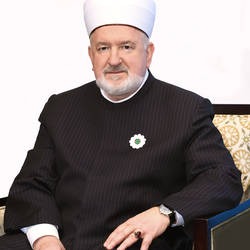
Dr. Mustafa Cerić
Grand Mufti Emeritus of Bosnia
Sarajevo, November 5, 2026
About the Author

Mufti Dr. Mustafa Cerić
Member of the Council of Interfaith, Salvator Mundi Global
Former Grand Mufti of Bosnia and Herzegovina, serving from 1993 to 2012, Islamic scholar and one of Europe's leading voices for interfaith dialogue and reconciliation.


Comments